Small money lessons.
More room for life.
Build your confidence with money. Learn to save, shop smarter and stand up for your consumer rights, one practical step at a time.

A good place to start



Start here
Where you stand, what you want and how GetGuac helps.
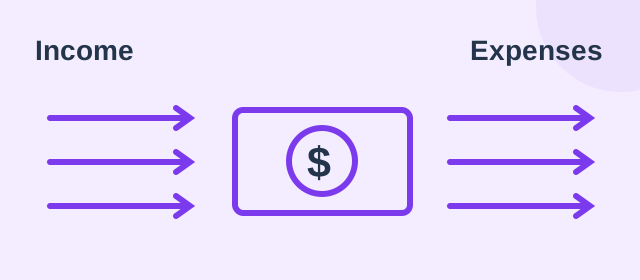
Know your money: a simple financial snapshot
Income, spending, what you own and what you owe — the four numbers every plan starts from.
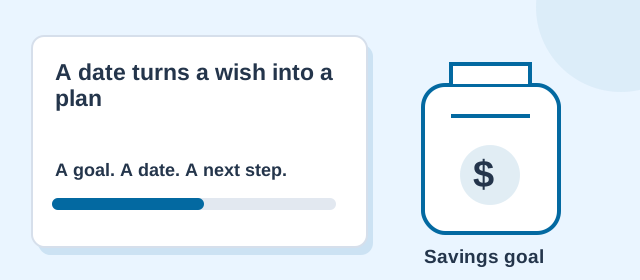
Turn a savings wish into a goal with a date
An amount, a date and a monthly number turn an intention into something you can finish.
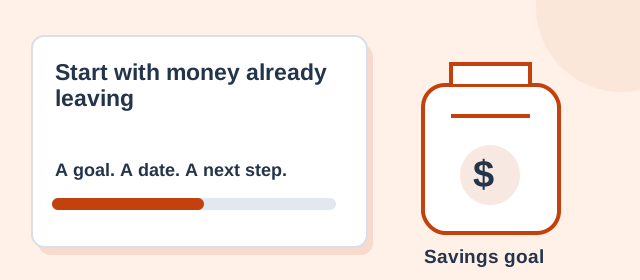
Find everyday savings with GetGuac
Not by budgeting harder — by showing you the money already leaking out of accounts you are not watching.
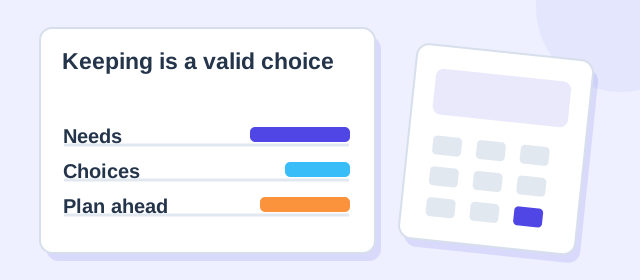
Small spending changes, more room for life
Keep the things you enjoy. Find one change that fits your life.
Budgeting and cash flow
A plan built from the month you actually had.
How to budget with the 50/30/20 rule
One simple split of your paycheck can replace a spreadsheet full of categories you'll never track.
How to build a zero-based budget in simple steps
Income minus every planned category equals zero. More upkeep than 50/30/20, but nothing is left to drift.
Sort your spending: fixed costs, flexible costs and choices
Sorting spending into three kinds shows which costs you can change this month and which need a bigger decision.
Let your receipts reveal where your money goes
Your memory underestimates your spending — receipts reveal the truth.
Plan ahead with sinking funds
Car registration, holiday gifts, and annual premiums aren't surprises — you just haven't saved for them yet.
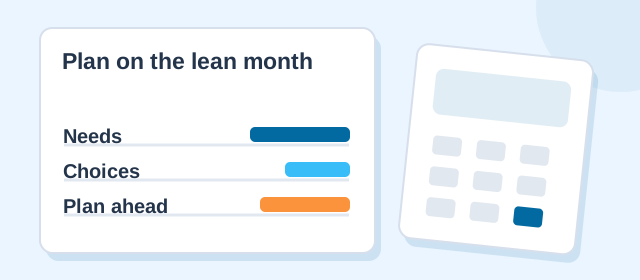
Build a budget when your income changes
Freelance, gig or commission pay? Plan on your lean month, park the extra and pay yourself a steady salary.
Pause before you buy: manage impulse spending
Most impulse buys follow a pattern — a mood, a place, a notification. A short pause breaks it without banning anything.
Keep more of your raise: avoid lifestyle inflation
Spending tends to rise to meet income. Decide where a raise goes before it arrives.

Make a monthly money check-in work for you
One short, regular review keeps a budget alive. Here is a simple agenda for it.
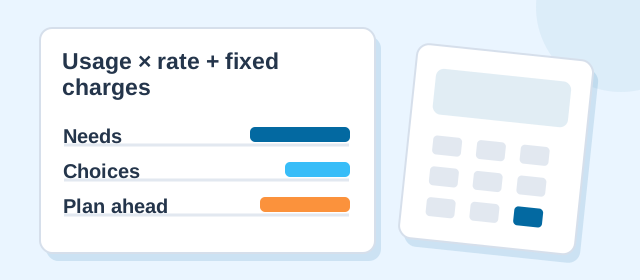
Read your utility bill and find ways to use less
Electricity and water bills are usage times rate plus fixed charges. Know the parts, then work on usage.
Emergency fund and savings
A cushion that stops surprises becoming debt.
Size your emergency fund for real life
Three to six months of expenses — but the right number depends on your specific situation.
Is it an emergency? Decide before you spend
Decide in advance what the fund is for — it is the simplest way to stop it quietly becoming spending money.
Find room in your budget for an emergency fund
Your fund lives at your bank. The money to fill it is usually already hiding in your own spending.
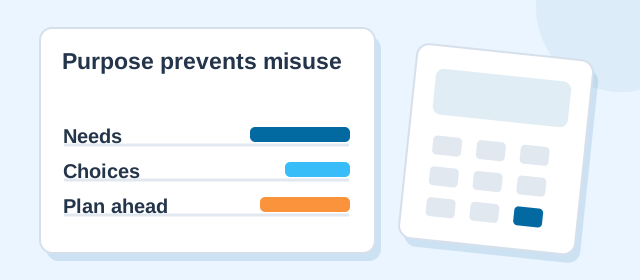
Give your cash three jobs: spending, buffer and emergencies
Three layers of cash — each with a job — stop small surprises from touching your emergency fund.
Compare high-yield savings beyond the headline rate
The cash in your big-bank savings account may be earning almost nothing — and the fix takes one afternoon.
Rebuild your emergency fund after a setback
Using the fund is what it is for. Rebuilding it fast is what keeps the next surprise from becoming debt.
See what inflation does to your cash savings
Inflation slowly reduces what cash can buy. That is fine for short-term money — and a reason long-term money needs a different home.
Smart spending
Groceries, bills and subscriptions, line by line.
Build a grocery budget you can stick to
Set your grocery number from your real receipts, not a hopeful guess, and it finally holds.
Make a grocery list that saves effort and waste
Compare useful alternatives, check what is already at home, and edit before you shop.
Read a grocery receipt and spot pricing mistakes
Tax codes, unit prices and promo lines — your receipt says considerably more than the total.
Review your subscriptions and stop paying for the unused
Free trials, forgotten apps, and duplicate streaming are draining your account every month.
Compare bills with confidence: prices, terms and tradeoffs
Understand the change, ask for written options, and choose what works for you.
Refunds and receipts
Money still owed to you, and the proof to claim it.
Claim a refund and follow it until it arrives
Return windows, price drops, and double charges — money is sitting there waiting to be claimed.
Check return deadlines before you buy
The clock starts at purchase, not when you open the box — and gift season quietly breaks that assumption.
How long should you keep each receipt?
Most receipts can go in a month. A few you should keep for seven years — and a handful until you sell the house.
Keep receipts searchable: paper, digital and backups
Thermal paper fades within months. Here is what to digitise, what holds up as a record, and where to put it.
Find the receipts hiding in your email
Order confirmations, renewals and e-receipts pile up in your inbox. Here is how to find them all in one sitting.
Debt and credit
Borrow well, pay down fast and protect your score.
Judge debt by its purpose, rate and total cost
Not all debt is created equal — the interest rate and what the money buys tell you which kind you have.
Choose a debt payoff plan: avalanche or snowball
Two proven payoff strategies — one saves the most money, one keeps you going. Here's how to pick.
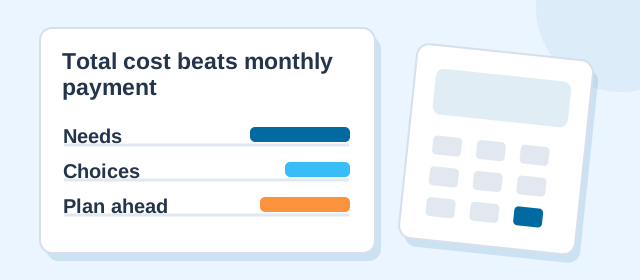
Compare debt consolidation without missing the fees
Combining debts can lower the rate or simplify payments — or quietly cost more. Compare total cost, not the monthly payment.
Use credit cards without carrying interest
Pay the full statement balance by the due date and a card costs nothing. Here is exactly how the grace period works.
Understand what moves your credit score
Two factors drive most of your score — and you can improve both without closing a single card.
Check your credit report and question errors
All three reports are free every week. Read them line by line, dispute errors with proof and freeze when you are not applying.
Protect your identity and know the recovery steps
Freezes, alerts and a recovery plan from IdentityTheft.gov. Most of the protection is free.
Respond to debt collectors with records and confidence
You have rights: written validation, the right to dispute and the right to limit contact. Verify before you pay.

Understand your student loan repayment options
Federal and private loans work differently. Federal repayment options changed on 1 July 2026 — know which loans you have first.

Compare car loans beyond the monthly payment
Negotiate the price first, bring your own financing quote and keep the term short. The monthly payment is the last number to look at.
Decode your mortgage payment: principal, interest, taxes and insurance
Principal, interest, taxes and insurance — the four parts of a typical monthly housing payment, and how they change over time.
Money mindset
The habits and biases behind every money decision.

Understand loss aversion before it drives a money decision
Losing $100 tends to feel worse than gaining $100 feels good. Knowing this helps you avoid panicked decisions.

Step back from financial FOMO
When everyone seems to be buying something, the fear of missing out can override a plan. Slow down on purpose.

Give every dollar the same value: mental accounting explained
A refund, a bonus and a paycheck are all just money. Treating “found” money as play money is a costly habit.
Make future savings easier than today’s impulse
Today’s wants feel more real than tomorrow’s needs. Automation and vivid goals make the future easier to choose.
Define enough and give your money a purpose
Without a definition of enough, every goal moves once you reach it. Write down what security and a good life cost for you.
Funds and portfolios
How growth works and how funds are built. Education only.
See how compound interest builds over time
Your returns start earning their own returns — and that changes everything.

Understand index funds, diversification and fees
Decades of data keep reaching the same conclusion: the boring fund usually beats the brilliant one.
What is an ETF? Understand the basket behind a share
An exchange-traded fund holds a basket of investments and trades on an exchange like a single share.
Compare ETFs and mutual funds without the jargon
“Index fund” describes the strategy; “mutual fund” and “ETF” describe how the fund is packaged and traded.
Understand the S&P 500 and what it leaves out
About 500 large US companies, weighted by size. Widely used as a benchmark — and not the whole market.

Explore total market funds and check the overlap
A total-market fund adds mid and small companies to the large ones — thousands of holdings in one fund.
Understand international diversification and currency risk
Companies outside the US make up a large part of the world’s stock market. Owning some spreads country risk.
Look beyond the story of a sector or thematic fund
Funds built around one industry or trend concentrate risk. Popular themes can already be priced in.
Understand a three-fund portfolio and rebalancing
US stocks, international stocks and bonds — a simple mix — plus a rule for keeping it on target.
Learn dollar-cost averaging: a schedule instead of market timing
Invest the same amount on a schedule and let math, not your nerves, decide when you buy.
Stocks and the market
How shares, prices and markets work. Never stock picks.
What is a stock? Understand ownership and risk
A share is a small piece of ownership in a company — with a claim on its future profits and its risks.
Compare common and preferred shares
Common shares usually vote and share in growth; preferred shares usually pay set dividends and get paid first.
Follow a stock trade from quote to exchange
Companies raise money once; after that, shares change hands between investors on exchanges.
Measure company size with market capitalization
Market cap is share price × shares outstanding — the market’s price tag for the whole company.
Read dividend yield without mistaking it for a promise
Some companies pay out part of their profit. Yield shows the payout relative to the price — and a very high yield can be a warning.
Decode the P/E ratio: price compared with profit
P/E shows how many dollars investors pay for each dollar of yearly profit. Useful for comparison, never a verdict on its own.

Understand growth and value investing styles
Growth focuses on fast-rising earnings; value on prices that look low against fundamentals. Neither wins every decade.
Follow an IPO from offer price to public trading
An initial public offering is a company’s first sale of shares to the public. Early trading can be volatile.
Tell a stock split from share dilution
A split changes the number of shares, not the value. Dilution is different — it can shrink your ownership share.
Understand market rises, falls and recovery math
Markets rise and fall in cycles. A plan made before the fall is the one that survives it.
Retirement accounts
401(k), IRA, HSA, Social Security and withdrawals.

Understand your 401(k) and employer match
Your employer's 401(k) match is an instant 50–100% return — here's how to claim every dollar.
Open the idea of an IRA: account first, investments inside
An individual retirement account works alongside — or instead of — a workplace plan, with traditional and Roth versions.
Compare Roth and Traditional IRAs through the tax timing
The difference comes down to one question: will your tax rate be higher now or in retirement?
Understand the backdoor Roth IRA and its tax pitfalls
A two-step route to a Roth IRA for people above the income limit — with a pro-rata rule that trips many up.
Understand an HSA’s tax benefits and receipt records
A health savings account gives you three separate tax breaks — and most people leave every one on the table.
Explore how claiming age changes Social Security benefits
Claiming at 62 permanently reduces benefits; waiting past full retirement age increases them up to 70.
Use the 4% rule as a starting point, with its limits
A rule of thumb from historical research for how much a retirement portfolio might support — useful as a starting point, not a promise.
Plan for required minimum distributions
Most pre-tax retirement accounts require withdrawals to start at 73 — rising to 75 for people who turn 74 after 2032.
Check the costs and commitments of early retirement withdrawals
Withdrawals before 59½ usually add a 10% tax. Substantially equal periodic payments are one exception — with strict rules.
Taxes
Brackets, deductions, gains and records, explained plainly.
Read tax brackets one layer at a time
A raise never lowers your take-home pay because of a higher bracket. Only the dollars above each threshold are taxed at the higher rate.
Tell a tax credit from a tax deduction
A deduction lowers taxable income; a credit lowers the tax itself. Dollar for dollar, a credit is usually worth more.
Compare the standard deduction with itemizing
You take whichever is larger. Most people take the standard deduction — and from 2026, non-itemisers can also deduct some cash gifts to charity.
Check sales tax before the receipt surprises you
The shelf price is never the final price — here is exactly why your total is always higher.
Keep the receipt records that matter at tax time
Most personal receipts have no tax value at all. A specific few do — and the difference is worth knowing.
Understand why holding time changes capital gains taxes
Hold an investment for more than a year and gains are usually taxed at lower long-term rates.
Understand tax-loss harvesting and the wash-sale rule
Selling an investment at a loss can offset gains — but the wash-sale rule disallows the loss if you rebuy too soon.

Plan for taxes as a W-2 employee or 1099 contractor
Contractors pay both halves of Social Security and Medicare, make estimated payments and keep their own records.
Keep charitable giving records and understand the tax rules
Keep the right records, know the 2026 non-itemiser deduction, and understand donor-advised funds.
Know when your taxes need a professional
Simple returns are often fine with software. Life changes, self-employment and big transactions are when help pays.
Housing and real estate
Big decisions, run with the real numbers.
Compare renting and buying with the full costs
The sticker price of a mortgage rarely tells the whole story — here's how to run the real math.

Check home affordability with the 28/36 guideline
A lender rule of thumb: housing up to 28% of gross income, all debt up to 36%. Your comfortable number may be lower.

Balance your down payment, PMI and cash cushion
Less than 20% down usually means private mortgage insurance on a conventional loan — and it can be removed later.
Count closing costs before you buy a home
Budget roughly 2–5% of the price on top of the down payment, and compare the Loan Estimate line by line.

Build a home repair reserve before something breaks
Roofs, water heaters and appliances wear out on a schedule. A monthly reserve turns big repairs into planned costs.

Explore shared housing costs and landlord responsibilities
Renting part of the home you live in can offset housing costs — and makes you a landlord, with rules to follow.

Understand REITs: property exposure through investments
Real estate investment trusts own income-producing property and pay out most of their taxable income.
Protection and estate planning
Insurance, wills and the people who depend on you.
Compare term and whole life insurance by the need
Term covers a set period at a lower cost; permanent policies add cash value at a much higher premium. Start with the need.
Understand how disability insurance protects income
Your ability to earn is often your biggest asset. Disability insurance replaces part of your income if illness or injury stops you working.
See where umbrella liability insurance fits
Extra liability coverage above your home and auto policies, for the rare large claim.

Understand what a will and living trust each do
A will says who gets what and who cares for children; a living trust can pass assets without probate. Many people need at least a will.
Choose who can act with powers of attorney
If you cannot act for yourself, these documents name who can — for money and for health decisions.
Plan college savings with a 529 account
Tax-free college savings that compound for years — and you control what happens if plans change.

Teach money skills with small choices and visible goals
Save, spend and give jars for young children; real decisions and real accounts for teenagers.